

What preparations do international patients need to make before coming to Vietnam for eye treatment?
Eye treatment abroad is not simply a matter of booking a flight and going to the hospital. For international patients, thorough preparation before the trip will help make the examination, diagnosis, and treatment process in Vietnam smoother, while minimizing complications related to medical records, schedules, costs, and length of stay.
From identifying treatment needs and preparing medical records to choosing a healthcare facility, arranging visas, flights, and companions, each step plays a specific role. Especially for cases requiring eye surgery, patients should discuss the procedure with their doctor and treatment facility beforehand to determine if they are suitable for the proposed method.
1. Clearly identify the eye problem and treatment goals.
Before choosing a medical facility in Vietnam, patients should determine what problem they need to be examined or treated for.
This could include a general eye exam, treatment for refractive errors, cataracts, retinal diseases, glaucoma, corneal diseases, age-related eye diseases, or the need for further specialized examination after a diagnosis has already been made in the country of residence.
For surgical procedures such as refractive error correction or cataract surgery, it should not be assumed that the method the patient desires is necessarily suitable. The final choice of method should be based on the results of a direct examination and assessment by the doctor.
2. Pay special attention if you are wearing contact lenses.
This is one of the very specific issues when preparing for an eye exam that patients often overlook. If you are using contact lenses, especially rigid contact lenses or corneal reshaping contact lenses, you should clearly inform your doctor and treatment facility before coming to Vietnam.
Contact lenses can temporarily alter the shape of the cornea. This can affect several important measurements, especially when assessing whether a patient is suitable for refractive surgery. Therefore, contact lenses should not be worn close to the date of an examination or surgery. The required discontinuation period depends on the type of lens and the individual's condition. Patients should ask their healthcare provider directly about the discontinuation period before any measurements are taken.
If you wear contact lenses, please provide the following information to your doctor beforehand:
- Type of lenses currently used: soft lenses, hard lenses, Ortho-K lenses...
- Time used.
- Frequency of wearing.
- The last time you used the glasses.
- Problems I've experienced while wearing contact lenses include dry eyes, red eyes, eye pain, or irritation.
This information is especially important for those planning to undergo LASIK, SMILE, or other refractive error correction procedures.

3. Prepare all necessary documents and previous eye examination results.
Medical records are one of the most important documents that international travelers should prepare before their trip.
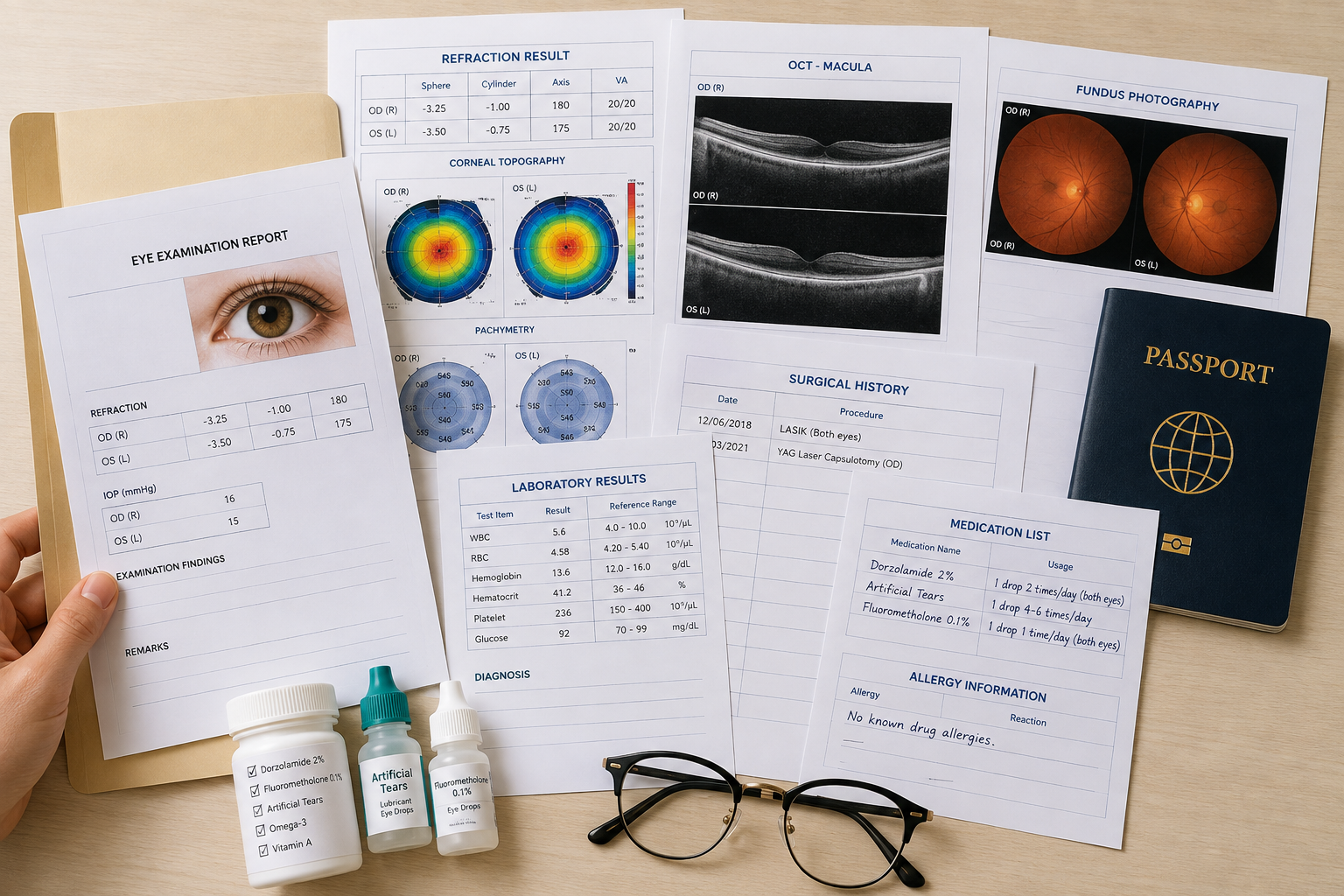
If applicable, the patient should bring the following:
- The results of the most recent eye exam.
- Current prescription and lens specifications.
- The results of the refraction measurement.
- Intraocular pressure measurement results.
- Fundus imaging, OCT, corneal mapping, or other specialized tests.
- Previous test results and diagnoses.
- Records of all eye surgeries or procedures performed.
- List of medications and eye drops currently being used.
- Information about drug allergies or any unusual reactions you have experienced.
If the documents are written in a language not commonly used in Vietnam, prepare an English translation or a summary in English. In complex cases, providing documents to the medical facility in advance for remote review by a doctor may make the initial consultation more effective.
Patients should also store their records electronically on their phones, email, or cloud storage, while keeping paper copies of important documents.
4. Discuss the planned eye treatment beforehand.
If traveling to Vietnam for a specific eye procedure or surgery, patients should ask basic questions beforehand, such as:
What is the proposed method?
What treatment method does the doctor plan to use for the eye, and what are the goals of that method?
Do I need to have my eyes re-examined in Vietnam?
In many cases, patients still need to undergo a full examination process before a doctor can confirm that treatment can be administered.
How long is the expected duration of eye treatment?
It is necessary to determine the time allocated for examinations, tests, treatment, follow-up visits, and post-treatment monitoring.
Do I need a follow-up examination before returning home?
This is especially important for international patients because the length of stay needs to be arranged to accommodate post-treatment eye care plans.
What if the eye exam results don't match the planned procedure?
Patients should understand that their eye treatment plan may change after a direct assessment by their doctor.
Discussing these issues beforehand helps patients avoid unrealistic expectations and be more proactive when planning their trip.

5. Check entry requirements and prepare your visa.
In addition to medical records, international visitors should check the entry requirements for Vietnam based on their nationality and passport status.
Vietnam currently has an official e-visa system from the Immigration Department, allowing foreigners to apply for electronic visas according to regulations. The information on the application must be filled out accurately and carefully compared with the passport.
Patients should check their passport expiration date, visa type, permitted length of stay, and entry requirements beforehand. If a medical facility or travel agency is assisting with the eye examination, they should discuss the necessary paperwork with them before booking their trip.
6. Check insurance and affordability.
Medical treatment abroad may not be covered by health insurance in the patient's country of residence. Therefore, before traveling, patients should contact their insurance company to confirm whether their policy covers treatment in Vietnam, including planned eye treatment and any unforeseen circumstances.
In addition to treatment costs, you should also consider expenses such as pre-treatment examinations and tests, medication, follow-up visits, accommodation, transportation, and any additional costs that may arise if your stay in Vietnam is longer than expected. Patients should also inquire with the medical facility about accepted payment methods and payment deadlines.
7. Arrange for a companion if needed.
Not all patients need an aide, but for older adults, those with limited vision, or those undergoing surgery, having a companion can make the journey more convenient.
Accompanying family members can assist at the airport, with transportation, receiving medication, remembering instructions from medical staff, and supporting the patient in the initial period after treatment.
If you plan to use eye drops multiple times a day or need to restrict certain activities after treatment, having someone to assist you can also help you adhere to the instructions better.
8. Plan your accommodation and transportation after treatment.
Patients should choose accommodation that is convenient for traveling to medical facilities, especially if they need to have multiple follow-up appointments.
If you have recently undergone an eye procedure or surgery, excessive travel, a busy schedule, or driving yourself may not be suitable depending on your condition and your doctor's instructions. Therefore, transportation arrangements from the airport or hotel to the hospital and vice versa should be prepared in advance.
For international patients, this is also one of the areas where a coordinated healthcare model can make a difference: instead of organizing each service separately, the journey can be connected from consultation, examination, treatment, accommodation, transportation to follow-up appointments.
Checklist before departure date
Medical records
- Eye exam results.
- Prescription lenses and lens specifications.
- Related imaging/diagnostic imaging.
- List of medications.
- Allergy information.
Administration
- Passport.
- Visa or appropriate entry document.
Trip
- Airline tickets.
- Booking information.
- Contact information for the hospital/coordinating unit.
Finance
- Confirm the estimated cost.
- Payment methods.
- Insurance information.
- Provision for unforeseen expenses.
Treatment
- Appointment schedule.
- The proposed treatment method.
- Length of stay.
- Follow-up appointment schedule.
- Contact person when problems arise.
You may also like

Specialized medical fields help Vietnam attract international patients.
In recent years, Vietnam has gained increasing attention on the regional medical tourism map thanks to the development of its hospital system, highly skilled medical professionals, increasingly modern medical technology,...

Vietnam's competitive advantage in medical tourism over Thailand, Malaysia, and Singapore.
Medical tourism in Southeast Asia is entering an increasingly competitive phase. Thailand, Malaysia, and Singapore are three markets that have established significant positions in the region, but each country has chosen...