

How to choose a suitable eye hospital in Vietnam?
The eyes are one of the most important organs in the body, so choosing the right hospital for examination and treatment is always a crucial factor in determining the effectiveness of treatment as well as the safety of the patient.
However, with dozens of specialized eye hospitals and numerous ophthalmology departments within general hospitals in Vietnam, choosing the right treatment facility is not always easy, especially for foreign patients. A well-known hospital may not necessarily be the best choice for your condition. Conversely, a medium-sized facility with expertise in your specific condition may offer better treatment outcomes.
How to make the right decision? Here are some important criteria that patients should consider before choosing an eye hospital in Vietnam.
Find out the number of surgeries performed each year.
In the field of ophthalmology, a hospital's practical experience is a crucial factor reflecting its professional competence. Facilities that perform a large number of surgeries annually typically have standardized procedures, a team of highly experienced doctors, and the ability to handle even complex cases effectively.
For example, if you need myopia surgery, find out how many LASIK or SMILE cases the hospital performs each year. If treating cataracts, prioritize hospitals with extensive experience in Phaco surgery and a regular track record of handling complex cases. For retinal diseases or glaucoma, the number of patients treated annually also reflects the capabilities of the specialized team.
Although the number of cases treated is not the only criterion for evaluating quality, it is an important indicator that helps patients understand the level of experience a hospital has in each specific area.
Find out about the qualifications and experience of the medical team.
The most important factor determining the quality of treatment is not the size of the building or the modern facilities, but the team of doctors.
A doctor with many years of experience in the specific field you need treatment in will be more likely to make an accurate diagnosis, prescribe appropriate treatment, and effectively manage complications and situations that may arise during treatment.
When researching an eye hospital in Vietnam, you can refer to information such as:
- The doctor's professional qualifications and academic degrees.
- Areas of specialized treatment.
- Treatment experience.
- Training both domestically and internationally.
- The number of surgeries performed.
- Ability to communicate with international patients.
For complex cases, don't hesitate to ask the hospital about the doctor who will be directly examining and performing the surgery. A reputable hospital will always readily provide this information transparently.

Evaluating the equipment system
Technological advancements have significantly transformed the quality of treatment in ophthalmology. Modern equipment not only facilitates early disease detection but also enhances surgical accuracy and reduces recovery time.
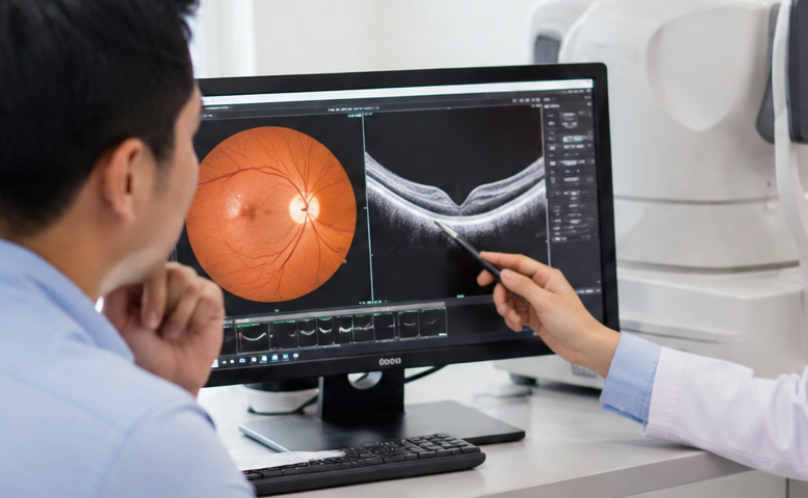
A well-invested hospital typically possesses systems such as optical coherence tomography (OCT) machines, digital fundus cameras, corneal mapping equipment, eyeball length measuring devices, therapeutic laser systems, next-generation surgical microscopes, and other equipment to support microsurgery of the eye.
For refractive surgery, patients should inquire about the type of laser machine the hospital is using, as well as the technologies applied in the measurement and treatment planning process. For cataract surgery, whether the hospital uses a modern support system can also affect the accuracy of the operation.
However, technology is only effective when operated by a team of experienced doctors. Therefore, evaluate both factors simultaneously instead of focusing solely on the equipment.
Learn about the different types of intraocular lenses and the supplies used.
For patients undergoing cataract surgery or Phakic ICL, the implant material is a factor that has a long-term impact on visual quality.
Patients should find out what types of intraocular lenses the hospital is using, where they come from, and whether there are options that suit their needs. Currently, there are many types of intraocular lenses such as monofocal, multifocal, focal length extender, or astigmatism corrector lenses, each with its own advantages and indications.
Instead of simply choosing the cheapest glasses, patients should discuss the differences between the options with their doctor, and then consider their eye condition, lifestyle needs, and budget.

Perform a comprehensive diagnostic assessment before prescribing treatment.
A reputable eye hospital focuses not only on performing surgeries but also invests heavily in the diagnostic process.
For example, before myopia surgery, patients need to be examined for corneal thickness, corneal topography, refraction, pupil size, retinal condition, and many other indicators to determine if they are eligible for surgery. Relying solely on the degree of myopia to decide whether to operate is insufficient.
Similarly, for cataract patients, accurately measuring eyeball length, corneal power, and calculating intraocular lens power will directly affect post-surgical vision.
A thorough and comprehensive examination process helps doctors develop an appropriate treatment plan, while reducing the risk of complications and minimizing the need for future interventions.
Choose a hospital capable of treating complex cases.
Not all cases are simple. Some patients may have multiple co-existing eye conditions or a history of systemic diseases such as diabetes, hypertension, or previous eye surgery.
In these cases, the hospital needs a team of doctors from various specialties such as cornea, retina, glaucoma, neuro-ophthalmology, and anesthesiology to coordinate treatment.
The ability to conduct multidisciplinary consultations helps develop comprehensive treatment plans, especially for high-risk cases or those requiring multiple techniques in a single treatment course.
Review certifications and quality standards.
Any surgical procedure needs to be performed in an environment that meets stringent safety requirements. Therefore, quality management certifications are a reliable indicator when choosing a hospital.
You can refer to the following:
- International quality management certification.
- Patient safety standards.
- Professional awards.
- Certification regarding infection control.
- Certification related to the quality of healthcare services.
While certification is not the sole factor determining quality, it serves as a basis for assessing the level of investment and commitment a hospital has to its patients.
Assessing the feasibility of post-operative monitoring.
Eye treatment doesn't end when the surgery is complete. The post-treatment follow-up phase plays a crucial role in ensuring long-term results.
For refractive surgery, patients typically require several follow-up visits in the first few months to assess corneal recovery. For patients with cataracts or retinopathy, these follow-up visits help detect early signs of abnormalities and adjust treatment plans if necessary.
For international patients, find out if the hospital offers online follow-up appointments, teleconsultation, or coordination with doctors in your home country. This is a significant advantage, as many patients will return home after only a few days or weeks of treatment.
Learn about treatment outcomes and success rates.
Besides showcasing modern technology, a reputable ophthalmology hospital also needs to be transparent about treatment results.
Patients can refer to indicators such as the rate of visual improvement after surgery, the complication rate, the rate of re-intervention, or the average recovery time for each type of surgery. Although these figures may vary depending on the disease group and individual patient characteristics, they are still a useful source of information for evaluating professional quality.
In addition to professional data, testimonials from patients who have successfully undergone treatment also help patients better understand the entire treatment process, from initial examination to post-operative care.
Compare costs comprehensively.
Cost is always a concern for many patients, but it shouldn't be the only criterion. Patients should request a cost estimate from the hospital or coordinating unit so they can proactively prepare their budget before the trip.
A hospital with lower prices may not necessarily be more economical if the patient requires additional tests or incurs extra fees. Conversely, a higher-priced treatment package that includes comprehensive examinations, tests, surgery, medication, follow-up appointments, and post-treatment care may offer better value.
Consider the possibility of combining treatment with a longer stay in Vietnam.
For international patients, length of stay is always an important factor when planning treatment.
Some procedures, such as a general eye exam or refractive surgery, can be completed in a short time, while treatment for retinal diseases, glaucoma, or corneal pathologies may require multiple follow-up visits or extended monitoring.
Before deciding on a hospital, patients should discuss the length of their stay in Vietnam, the expected number of follow-up visits, and their preferred return date. This allows for proactive scheduling, flight bookings, and accommodation plans, while also preventing premature departures that could negatively impact treatment outcomes.
Choose a reputable medical tourism coordinator.
For international visitors unfamiliar with the Vietnamese healthcare system, independently researching and contacting numerous hospitals can be time-consuming.
This is where the role of medical tourism coordination agencies becomes crucial.
Instead of simply recommending a hospital, the coordinating unit will use the patient's medical records, treatment needs, length of stay, and budget to suggest the most suitable options. They will also assist with preparing paperwork, scheduling appointments, coordinating itineraries, translation, accommodation, transportation, and post-treatment follow-up.
Having a single point of support throughout the process helps patients reduce stress during preparation and creates an effective connection between patients and healthcare facilities.

You may also like

What preparations do international patients need to make before coming to Vietnam for eye treatment?
Eye treatment abroad is not simply a matter of booking a flight and going to the hospital. For international patients, thorough preparation before the trip will help make the examination, diagnosis, and treatment process...

Specialized medical fields help Vietnam attract international patients.
In recent years, Vietnam has gained increasing attention on the regional medical tourism map thanks to the development of its hospital system, highly skilled medical professionals, increasingly modern medical technology,...